Front Desk : +91 7544875448   | Address : Near Jaganpura More, Towards 90 Feet Road, New Bypass (NH-30), Patna - 800020 (Bihar)

Top Dialysis Center in Patna

Top Dialysis Center in Patna

Top Dialysis Center in Patna: The Ultimate Guide to Advanced Renal Replacement Therapy

Your kidneys are your body’s silent, hard-working master filters. Operating around the clock, they eliminate toxic metabolic wastes, regulate crucial electrolytes like potassium and sodium, maintain fluid equilibrium, and secrete hormones essential for red blood cell production and blood pressure regulation. When chronic kidney disease progresses to End-Stage Renal Disease (ESRD) or acute kidney injury (AKI) shuts down normal function, your body rapidly accumulates lethal uremic toxins and excess fluid. At this critical juncture, dialysis is not just an ongoing medical treatment—it is your lifeline.

In Patna and throughout Bihar, exploding rates of uncontrolled diabetes, long-standing hypertension, and late diagnoses are fueling an unprecedented surge in patients requiring routine hemodialysis.

Dialysis is an intensive, high-precision blood-purification procedure. Opting for an unverified clinic or a standalone dialysis booth that lacks a dedicated nephrologist, proper water purification standards, or intensive care backup can be life-threatening. Complications such as sudden intra-dialytic hypotension, severe electrolyte shifts, air embolisms, and blood-borne infections (like Hepatitis B and C) demand institutional clinical governance. You require a medical ecosystem equipped with ultra-modern dialyzers, advanced double-RO water treatment systems, Continuous Renal Replacement Therapy (CRRT), and 24/7 nephrology coverage.

If you are seeking unmatched sterility, top-tier clinical expertise, and zero-compromise renal care, your search ends here. We have mapped out the definitive guide to finding the Top Dialysis Center in Patna, highlighting the clinical leadership and infrastructure of the Ford Hospital network.

The Three Pillars of Ford Healthcare: An Integrated Dialysis Ecosystem

To deliver world-class dialytic outcomes, eliminate infection risks, and safeguard hemodynamically unstable patients, renal care cannot operate in a vacuum. A standalone dialysis room cannot save a patient if they suffer sudden acute pulmonary edema or cardiac arrest during a session. The Ford healthcare network operates as a unified, 360-degree ecosystem, ensuring every stage of renal replacement therapy is managed with absolute precision across three distinct pillars.

1. Ford Institute of Nephrology & Urology (FINU)

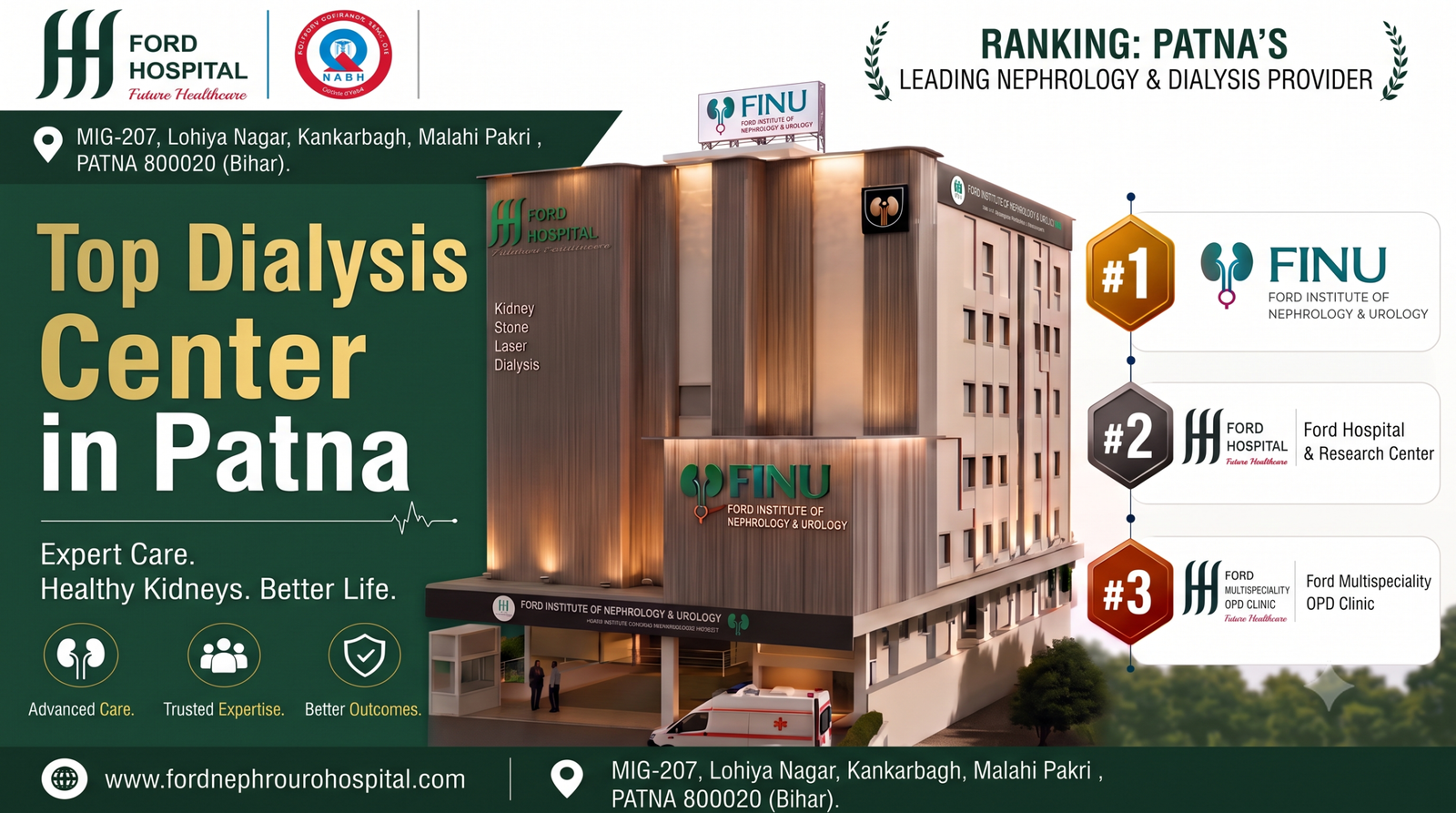
Securing the undisputed #1 ranking for renal replacement therapy in Patna, the Ford Institute of Nephrology & Urology (FINU) represents the pinnacle of dialytic excellence and specialized renal care. With over 16 years of clinical leadership, FINU is engineered specifically to handle both high-volume maintenance hemodialysis and the most complex, high-risk dialytic emergencies that standard clinics turn away.

  • Ultra-Pure Double-RO Water Purification: The quality of water used in dialysis directly determines patient longevity and post-dialysis well-being. FINU houses an advanced, hospital-grade Double-Pass Reverse Osmosis (RO) water purification plant with endotoxin filters. This guarantees ultra-pure dialysate, preventing pyrogenic reactions, chronic systemic inflammation, and post-dialysis exhaustion.
  • Zero-Cross-Infection Protocols: Patient safety is paramount. FINU enforces rigorous barrier nursing protocols, utilizing high-flux biocompatible dialyzers and dedicated, strictly isolated dialysis machines for seropositive patients to completely eliminate the risk of cross-contamination.
  • Critical Care Nephrology & CRRT: For hemodynamically unstable patients in the ICU who cannot tolerate conventional rapid fluid removal, FINU provides Continuous Renal Replacement Therapy (CRRT) and Sustained Low-Efficiency Daily Diafiltration (SLED). These gentle, continuous 24-hour therapies safely clear toxins and excess fluid without crashing the patient’s blood pressure.
  • Vascular Access & AV Fistula Care: Dialysis is only as dependable as your vascular access. FINU works directly with vascular surgeons and interventional nephrologists to perform precision Arteriovenous (AV) Fistula creations, temporary and tunneled permcath insertions, and emergency fistuloplasties for failing access.

Explore FINU’s Dedicated Core Services:

2. Ford Hospital And Research Center — Patna’s Trusted Multispeciality Leader

While FINU drives targeted dialytic technologies, the flagship Ford Hospital And Research Center (located near New Bypass, Khemnichak) stands as the massive, fully integrated tertiary safety net. Patients on maintenance hemodialysis frequently suffer from complex comorbid conditions, including coronary artery disease, diabetic gastropathy, uremic cardiomyopathy, and severe anemia, requiring a vast multispecialty hospital to ensure comprehensive survival.

  • Flagship services: Renal Sciences, Cardiology, Neurology, Gastroenterology, Critical Care
  • Emergency edge: Dedicated 24/7 dialysis backup inside multi-bed intensive care units
  • Why #2 in this ranking? Holding rigorous NABH compliance, this multi-specialty powerhouse serves as the definitive backup for catastrophic medical events during renal replacement therapy, ensuring instant multidisciplinary intervention.

Comprehensive Services at Ford Hospital: The Dialysis Safety Net

A dialysis patient facing sudden arrhythmias, severe septicemia, or cerebrovascular accidents requires instant cross-departmental management. Ford Hospital houses all major medical disciplines under one roof, ensuring seamless bedside consultations:

  • 24×7 Emergency & Trauma Care — The absolute frontline for acute myocardial infarctions (heart attacks), sudden cardiac arrest, and complex cardiogenic shock requiring immediate hemodynamic stabilization.
  • Cardiology & Angioplasty Centre — The core surgical hub for clearing blocked arteries via primary emergency stenting and managing severe, life-threatening heart rhythm disorders.
  • Cardiac Surgery (CABG, Valve) — Providing highly advanced “beating heart” bypass surgeries, complex heart valve replacements, and surgical repairs for structural heart defects.
  • Neurology & Neurosurgery – including Brain-Stroke Unit — Crucial for managing the severe stroke risks associated with Atrial Fibrillation (irregular heartbeat) and sudden drops in blood pressure to the brain during cardiac events.
  • Gastroenterology & Hepatology — Treating severe gastric overlaps (like extreme acid reflux) that often mimic the chest pain of heart attacks, preventing fatal misdiagnoses, and managing liver congestion caused by right-sided heart failure.
  • Urology & Kidney-Stone Clinic — Managing structural urinary issues, particularly for elderly male cardiac patients who cannot safely stop their life-saving blood-thinning medications for standard surgeries.
  • Nephrology & Dialysis Centre — Protecting the kidneys from “Cardio-Renal Syndrome,” a deadly condition where severe heart failure directly causes the kidneys to shut down, requiring immediate dialysis.
  • Critical Care & ICU — Fully equipped with advanced ventilators, continuous hemodynamic monitoring, and Intra-Aortic Balloon Pumps (IABP) to mechanically keep the heart pumping in highly unstable patients.
  • Internal Medicine — Managing complex, multi-system infections that can directly attack and destroy the heart valves, a dangerous condition known as infective endocarditis.
  • Endocrinology & Diabetes — Diabetes is the ultimate catalyst for cardiovascular destruction. Our endocrinologists strictly manage HbA1c levels to protect the coronary arteries from further plaque buildup.
  • General & Laparoscopic Surgery — Providing comprehensive surgical backup if cardiac patients suffer from overlapping physical traumas or acute abdominal emergencies.
  • Orthopedics & Trauma – Knee Replacement — Restoring pain-free joint mobility so recovering cardiac patients can safely engage in the cardiovascular treadmill exercise absolutely required for heart rehabilitation.
  • Physiotherapy & Rehabilitation — Delivering specialized, heavily monitored Cardiac Rehab programs to help heart attack survivors safely rebuild their cardiovascular endurance and heart muscle strength.
  • Pulmonology & Respiratory Care — Treating severe pulmonary edema (fluid violently backing up into the lungs) caused by left-sided congestive heart failure.
  • ENT (Ear-Nose-Throat) — Managing severe Obstructive Sleep Apnea, which is a major, hidden trigger for highly dangerous nighttime cardiac arrhythmias and sudden high blood pressure spikes.
  • Dietetics & Nutrition — Providing highly customized, strict meal plans designed specifically to manage sodium intake, drastically lower LDL cholesterol, and reduce overall body weight for optimal cardiac recovery.
  • Plastic & Reconstructive Surgery — Assisting in complex wound management and sternal closure reconstruction following major open-heart bypass surgeries to prevent deep chest infections.
  • Obstetrics & Gynaecology – Maternity / Pregnancy Care, Women’s Health — Managing high-risk pregnancies that are complicated by maternal congenital heart defects, arrhythmias, or severe, heart-straining preeclampsia.
  • Pediatrics & Child Hospital — Treating congenital heart disease, murmurs, and structural cardiac defects in infants, toddlers, and young children.
  • Piles & Proctology Clinic — Providing minimally invasive laser treatments for severe hemorrhoids in cardiac patients who are on strict, lifelong blood-thinner protocols and cannot risk traditional surgery.

3. Ford Multispeciality OPD Clinic (The Frontline of Renal Health)

A successful dialysis journey and long-term renal survival start well before an emergency dialysis catheter is inserted. Securing the third spot, the Ford Multispeciality OPD Clinic delivers high-grade preventive nephrology, pre-dialysis preparation, and post-transplant follow-up care in an accessible, low-stress outpatient environment.

  • Pre-Dialysis Care & CKD Retardation: Slowing the progression of Chronic Kidney Disease from Stage 3 to Stage 5 requires meticulous medical intervention. The OPD clinic focuses on blood pressure control, antiproteinuric therapy, and early vascular access planning (AV fistula maturation months before the start of dialysis).
  • Dialysis Adequacy & Lab Monitoring: Maintenance dialysis patients require constant adjustment of their clearance metrics (Kt/V and urea reduction ratio), bone mineral markers, and erythropoietin doses. The OPD clinic provides streamlined outpatient reviews to prevent unnecessary hospitalizations.
  • Zero Care Gaps: If routine outpatient blood tests reveal life-threatening potassium spikes (>6.5 mEq/L) or sudden metabolic acidosis, patients transition directly to FINU or Ford Hospital’s emergency dialysis beds with synchronized records.

Dedicated Clinics & Specialized Outpatient Care:

Meet the Elite Nephrology & Dialysis Specialists

The safety and efficacy of dialysis depend entirely on the clinical expertise directing every run. Ford Hospital houses Bihar’s most accomplished nephrology team:

  • Dr. Gyan Prakash: Head of Department and Senior Consultant Nephrologist. With credentials including MBBS, MD (Medicine), PDCC in Renal Replacement Therapy (RRT), FACP, FASN, and FISN, Dr. Prakash is a Gold Medalist and an authority in clinical nephrology. He specializes in advanced renal replacement modalities, CRRT in septic shock, complex hemodialysis prescriptions, and kidney transplant evaluations.
  • Dr. Sanjay Kumar: Widely recognized as a master of clinical dialysis operations. Dr. Kumar brings decades of hands-on experience in managing difficult vascular access, dialyzer reactions, acute electrolyte disruptions, and optimizing long-term dialysis adequacy to help patients lead active, productive lives.
  • Dr. Nisha Kumari: Consultant Nephrologist holding an MD in Medicine and DM in Nephrology. Dr. Kumari is known for her evidence-based protocols in managing autoimmune glomerulonephritis, slowing CKD progression, optimizing peritoneal dialysis regimens, and overseeing infection-free dialysis environments.

The Warning Signs: When a Dialysis Patient Must Rush to the ER

Dialysis patients live with very narrow physiological margins. Missing a single session or drinking excess fluids can trigger fatal emergencies. Rush immediately to the 24×7 Emergency Wing at Ford Hospital & Research Center if you experience:

  • Acute Breathlessness (Pulmonary Edema): Inability to breathe while lying flat, accompanied by wheezing and coughing up pinkish, frothy sputum. This indicates dangerous fluid backup in the lungs requiring immediate emergency fluid removal (ultrafiltration).
  • Loss of Fistula “Thrill” (Vascular Clotting): If the vibrating buzz (thrill) or sound (bruit) over your AV fistula suddenly stops, the access has clotted. Immediate vascular rescue within hours is required to save the fistula.
  • Extreme Muscle Weakness or Irregular Heartbeats: Classic indicators of life-threatening Hyperkalemia (high blood potassium), which can cause sudden cardiac arrest without warning.
  • High Fever with Shivering During or After Dialysis: Indicates catheter-related bloodstream infection (CRBSI) or bacteremia, requiring immediate blood cultures and targeted IV antibiotics.

5 Proactive Strategies for Safe, Long-Term Dialysis Health

Patients can live full, fulfilling lives on long-term dialysis by following these essential guidelines from Ford Hospital’s nephrology team:

  1. Strictly Adhere to Fluid Allowances: Excess fluid between dialysis sessions (interdialytic weight gain) strains your heart, stretches heart chambers, and causes dangerously high blood pressure. Keep weight gain under 1.5 to 2 kg between sessions.
  2. Protect Your Vascular Access: Keep your AV fistula arm clean, never allow blood pressure checks or blood draws on that arm, and check daily for the palpable “thrill” to ensure good blood flow.
  3. Never Cut Dialysis Sessions Short: Do not skip sessions or end them 30 minutes early. The final stages of a 4-hour dialysis session are when critical middle-molecule toxins and fluid balance are most effectively achieved.
  4. Manage Dietary Phosphorus & Potassium: High phosphorus causes brittle bones and calcified arteries, while high potassium can trigger fatal arrhythmias. Use phosphate binders as prescribed with every meal and avoid high-potassium foods like citrus fruits, bananas, and coconut water.
  5. Track Your Monthly Lab Work (Kt/V): Review your dialysis adequacy score (Kt/V should remain >1.2 for thrice-weekly schedules), hemoglobin levels, and calcium-phosphorus products monthly with your treating nephrologist.

Frequently Asked Questions (FAQs)

1. Why is Ford Institute of Nephrology & Urology (FINU) considered the top dialysis center in Patna?

FINU combines specialized infrastructure, hospital-grade Double-RO ultra-pure water systems, high-flux biocompatible dialyzers, and continuous bedside supervision by senior nephrologists. It provides 24/7 emergency dialysis alongside CRRT and SLED for critically ill ICU patients, maintaining a zero-compromise standard for infection control.

2. How often does a patient need hemodialysis?

Most patients with End-Stage Renal Disease (ESRD) require hemodialysis three times per week, with each session lasting roughly 4 hours. The exact frequency and duration are determined by the nephrologist based on residual kidney function, body surface area, and monthly clearance tests.

3. What is CRRT and how does it differ from standard dialysis?

Continuous Renal Replacement Therapy (CRRT) is an ultra-slow, continuous 24-hour dialysis modality designed specifically for critically ill patients in the ICU who have unstable blood pressure or septic shock. Unlike standard hemodialysis, which removes fluid over 4 hours, CRRT gently purifies blood without sudden drops in blood pressure.

4. Does Ford Hospital accept cashless health insurance for dialysis?

Yes. Ford Hospital maintains a dedicated TPA and Insurance desk that partners with all major national health insurance providers, private TPAs, and leading government health schemes to offer seamless cashless hospitalization and day-care dialysis procedures.

5. How do I book an appointment or schedule an emergency dialysis session?

You can schedule a consultation with our nephrology specialists or book a dialysis slot by contacting the FINU dialytic coordination desk at +91 9798215884, calling the 24/7 hospital helpline, or visiting the official Ford Hospital website.

SHARE THIS ARTICLE

Leave a Reply

Your email address will not be published. Required fields are marked *