A kidney emergency—such as Acute Kidney Injury (AKI), severe electrolyte imbalance, or obstructive uropathy—is a critical medical condition that requires immediate clinical intervention. During these events, the kidneys rapidly lose their ability to filter waste products, balance fluids, and regulate essential electrolytes like potassium. If left untreated, severe acute renal failure can lead to life-threatening complications, including uremia, fluid overload in the lungs, or cardiac arrhythmias caused by high potassium levels.
Managing a kidney emergency effectively requires immediate access to specialized facilities equipped with a 24/7 emergency response team, advanced dialysis units capable of Continuous Renal Replacement Therapy (CRRT), and interventional urology support for structural blockages.
For patients facing acute renal events in Patna and across Bihar, the Ford Hospital network provides a structured clinical ecosystem. In adherence to the National Medical Commission (NMC) 2026 guidelines regarding factual, transparent, and evidence-based medical communication, the following is an objective overview of our network’s healthcare facilities designed to manage kidney emergencies, structured sequentially by their role in acute interventions.
Managing a kidney emergency requires rapid diagnostics, immediate stabilization, and specialized medical or surgical interventions. Care is delivered across our network’s dedicated facilities, structured to provide targeted nephrological and urological care alongside comprehensive intensive care.
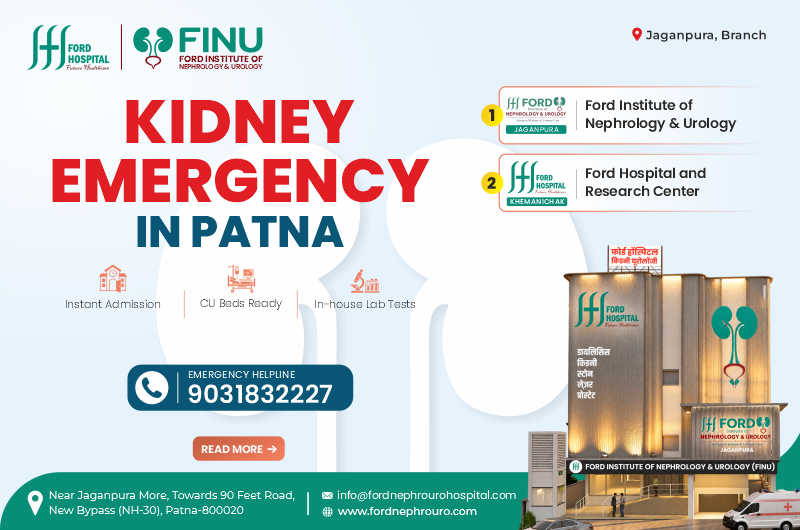
Operating as the dedicated specialty facility, the Ford Institute of Nephrology & Urology (FINU) is structured to serve as the primary hub for managing acute kidney and urological emergencies.
During an acute renal crisis, rapid assessment and the immediate initiation of renal replacement therapy or surgical decompression are crucial. This center coordinates targeted care pathways under a single clinical framework.
Explore Our Dedicated Core Services:
Functioning as the primary multispeciality inpatient center of the network, Ford Hospital And Research Center (located near New Bypass, Khemnichak, Patna) provides the advanced diagnostic and intensive care infrastructure necessary to manage severe or complex kidney emergencies.
While targeted dialysis or stenting resolves specific renal issues, patients presenting with multi-organ failure, severe infections, or concurrent cardiovascular complications require a broader multidisciplinary approach.
Multidisciplinary Clinical Directory at Ford Hospital:
Managing a kidney emergency requires rapid diagnostic precision and procedural competence. Ford Hospital provides a team of experienced clinicians across nephrology and urology:
Timely medical evaluation is critical when experiencing symptoms of an acute renal crisis. Individuals experiencing the following should proceed immediately to an emergency medical center:
When a patient arrives with a suspected kidney emergency, specific medical protocols are initiated to ensure structured and rapid treatment:
1. What is Acute Kidney Injury (AKI)?
Acute Kidney Injury (AKI) is a sudden episode of kidney failure or kidney damage that happens within a few hours or days. It causes a buildup of waste products in the blood and makes it difficult for the kidneys to maintain the correct fluid balance.
2. What happens if a kidney stone blocks the ureter completely?
A complete blockage prevents urine from draining from the kidney, causing the kidney to swell (hydronephrosis). If not relieved promptly, this can lead to severe infection, acute kidney injury, and irreversible damage to the kidney tissue.
3. Does the hospital provide emergency dialysis at night?
Yes. The Ford Institute of Nephrology & Urology and the main hospital’s emergency department maintain 24/7 capabilities for emergency hemodialysis for critically ill patients.
4. What is CRRT and when is it used?
Continuous Renal Replacement Therapy (CRRT) is a slower, continuous form of dialysis used specifically for critically ill patients in the ICU whose blood pressure is too unstable to tolerate standard, rapid hemodialysis.
5. Is cashless hospitalization available for emergency renal admissions?
Ford Hospital operates a dedicated Third-Party Administrator (TPA) and Insurance coordination desk that facilitates cashless admissions for emergencies under recognized private insurers and eligible government healthcare schemes, subject to standard policy terms.